

CUSTOM FASTENERS: DESIGN BASED ON GUARANTEED MINIMUM VALUES FOR HIGHER RELIABILITY
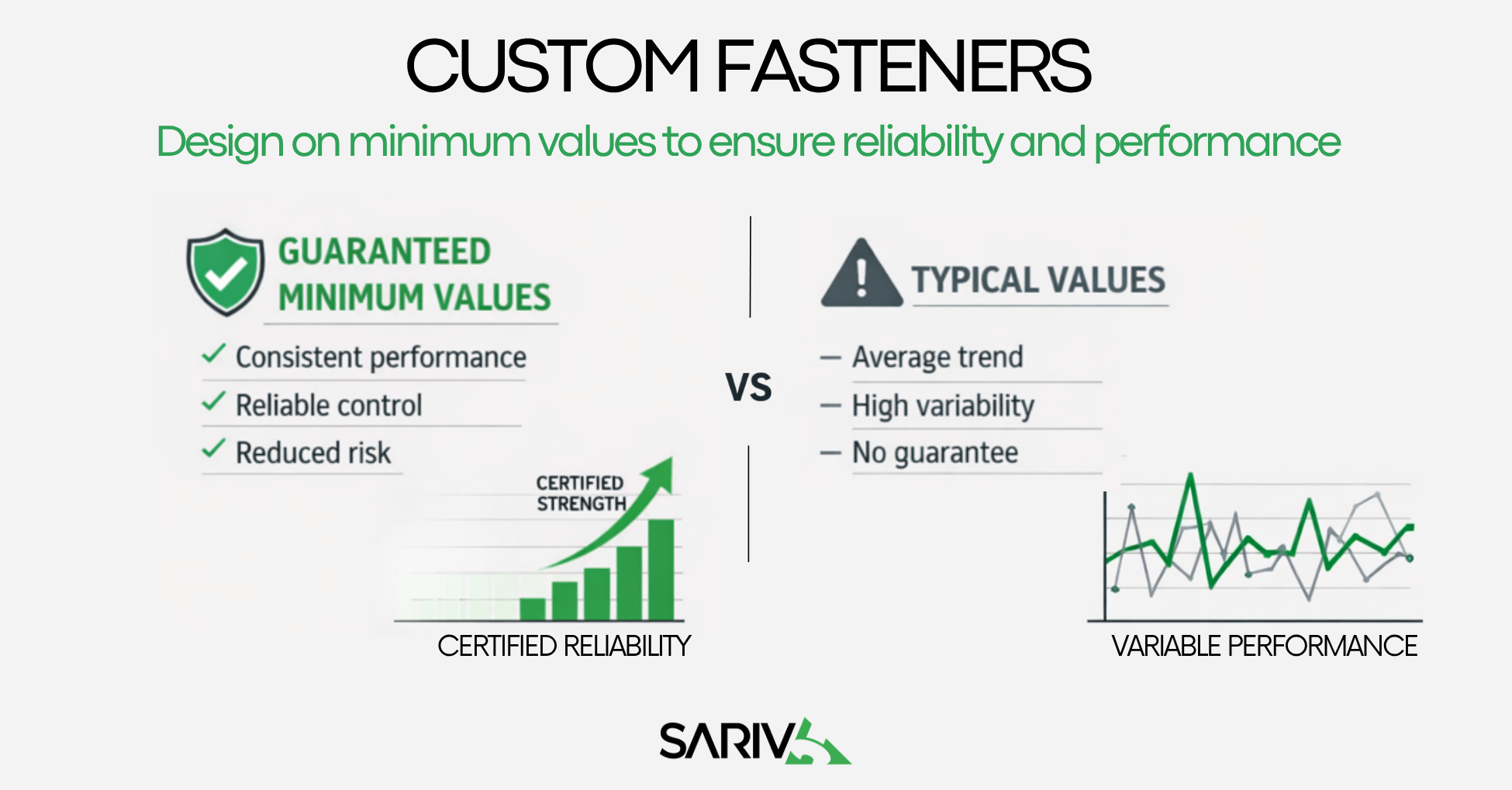
Designing fastening systems based on guaranteed minimum values ensures greater reliability, control, and consistency compared to using typical values that are only indicative.
✔ WHY MINIMUM VALUES MAKE THE DIFFERENCE IN DESIGN
Reliability, consistency, and safety start with the right values.
In the design of fastening systems, guaranteed minimum values are not just numbers: they are the concrete reference that ensures consistent performance, regardless of material or production process variability.
In contrast, typical values provide only an average indication—useful, but not sufficient as a design basis.
Discover why designing based on minimum values means making solid, verifiable, and reliability-focused choices over time.
✔ MINIMUM VALUES: THE DESIGN REFERENCE
Minimum values are defined by standards (e.g., strength classes) and represent the guaranteed level that every component must meet.
They are not average values, but certified lower limits, determined by considering:
material variability
process deviations
real production conditions
For this reason, they implicitly incorporate a safety factor.
Designing based on these values means working with data that is:
verifiable
repeatable
valid for every compliant batch
✔ TYPICAL VALUES: AN INDICATION, NOT A GUARANTEE
Typical values describe average performance observed under certain production conditions. However:
they are not standardized
they are not guaranteed for every supply
they do not account for application variability
Therefore, they are indicative—useful for understanding general behavior, but insufficient as a design basis.
✔ IMPLICATIONS FOR DESIGN
Using typical values as a reference may lead to:
overestimation of available performance
unintended reduction of safety margins
greater variability in joint behavior
Conversely, designing based on minimum values allows you to:
maintain consistency between design and production
ensure performance even under variable conditions
reduce the risk of failure or preload loss
In critical contexts, this choice is decisive for system reliability.
✔ A CONTROL-BASED APPROACH
Relying on minimum values does not mean being inefficiently conservative, but designing on solid and verifiable foundations.
In this context, the ability to control the production process becomes central:
material quality
treatments
performance
process stability
✔ SARIV'S CHOICE
SARIV develops custom fastening systems, designed according to the application and manufactured in-house.
This allows:
guaranteeing compliance with standard minimum values
ensuring consistency between specification and actual product
maintaining high repeatability thanks to IATF 16949 and ISO 9001 certified processes
Focusing on minimum values is not a limitation, but a design choice oriented toward long-term reliability.